
Feminism and Simone de Beauvoir
To be able to speak about feminism we must already ask ourselves the question of its definition. But there are several definitions of feminism :
- « A militant movement for the improvement and extension of the role and rights of women in society." Larousse Dictionary
- « feminism is a set of political, philosophical and social movements and ideas, which share a common goal: to define, establish and achieve political, economic, cultural, personal, social and legal equality between women and men." Wikipedia
So we can say that the definition of feminism s something quite personal to each person, however they often come together on certain points: women have and should have the same rights as men (equality man and woman), the gender of a person can not justify a difference in treatment, to break down prejudice against women.
So everyone can be a feminist, even a man, because feminism es a set of movements and philosophical ideas that aim to define and promote equality (at different levels: political, economic, cultural, social and legal) between women and men by fighting for women's rights in society and in private life.
Example of a feminist woman :
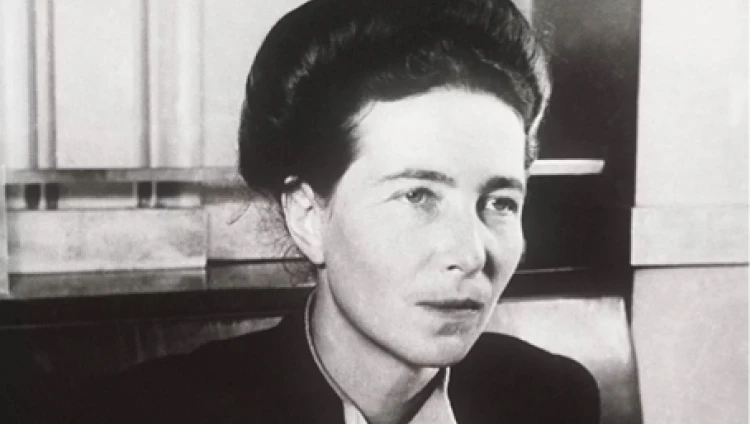
Simone de Beauvoir was born on January 9, 1908 in Paris and died on April 14, 1986 in Paris. She is a philosopher and writer.
She began to be known in 1949, by her feminism and existentialist essay "the second sex", where she advocates equality in the difference.
Then she published the novel "The Mandarins" and won the Goncourt Prize in 1954.
From 1958 she published autobiographical stories such as "Memoirs of a young girl row" which speaks of his environment full of prejudice.
She also participated in the creation of the existentialist «magazine "Les Temps Modernes" in 1945, and also played an important role in the recognition of the torture inflicted on women during the Algerian War and for the right to abortion, in the struggles of Gisèle Halimi and Elisabeth Badinter.
She is considered as a pioneer dof women's liberation by the feminist movements, she has demonstrated all her life that one can be a woman while being independent and free.

On what subjects was she known ?
And she was especially known on three topics:
The first is the mental load and domestic work, where she already explained how women were suffering a double day, because household chores is an additional unpaid workload, and already fought for a fairer distribution of tasks.
The second is the female body, of which she explained the menstruation, the vagina or the clitoris. And in the second sex she talked about the physiological functioning of the female organs, which at the time shocked a lot and was criticized, because she talked about a subject that was still taboo at the time, the sexuality of women and female pleasure.
And the last one is sexual freedom, where in her novel The Guest of 1943 she was inspired by her own love trio, with Jean-Paul Sartre, with whom she remained a free couple all her life, and Olga Kosakiewicz, one of her former students. She did not hide sleeping with other people, man or woman. And she did not want to marry or have children, she preferred to be free and live her life as she wanted.
Glossary